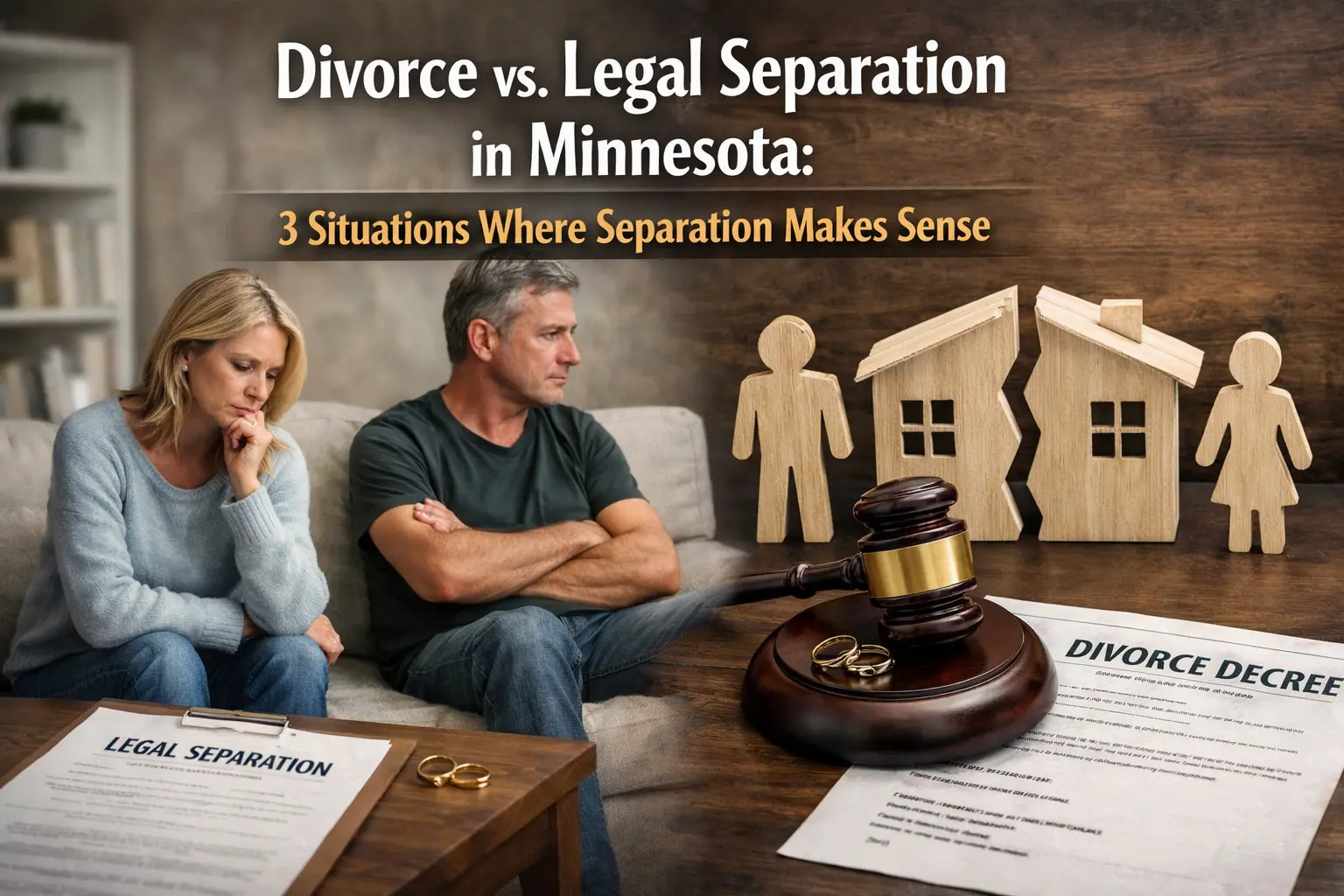
Divorce vs. Legal Separation in Minnesota: 3 Situations Where Separation Makes Sense
Most people asking about legal separation in Minnesota should probably just get divorced. I know that sounds blunt coming from a family law attorney, but it is the honest answer, and it will save you time, money, and a lot of confusion. That said, there are three specific situations where legal separation is the smarter move, and if you are in one of them, it matters a lot.
What Is the Difference Between Divorce and Legal Separation in Minnesota?
A divorce dissolves your marriage entirely. You divide your assets and debts, work out custody and parenting time if you have kids, and when it is over you are legally single and free to remarry.
A legal separation does almost all of the same things. You still divide property, address child custody, child support, and handle spousal maintenance, and deal with every financial issue in the marriage. The difference is that when it is done, you are still legally married. You cannot remarry. In most cases you cannot even complete a name change during the separation.
Same work, same cost, same emotional weight, and you are still married at the end.
This is why I tell people: a legal separation is not a shortcut, it is not cheaper, and it is not simpler. It is essentially a divorce that leaves the marriage technically intact. My somewhat wise-ass version of this is that I love doing legal separations because I get to do the same case twice (and charge for it). There is real truth in that joke.
Is Legal Separation Easier or Cheaper Than Divorce in Minnesota?
No, and this is one of the most common misconceptions I run into. People imagine a legal separation as signing a quick document and calling it done. That is not how it works under Minnesota law.
Under Minn. Stat. § 518.06, a legal separation requires the court to address child custody, parenting time, child support, spousal maintenance, division of real property, division of debts, and health insurance for the children. That is the same list you work through in a divorce. If you expect to pay less because you are choosing separation over divorce, you will be disappointed.
3 Situations Where Legal Separation Makes More Sense Than Divorce in Minnesota
1. You Just Moved to Minnesota and Can’t Wait to File
Minnesota requires you to have lived in the state for at least 180 days before you can file for divorce. There is no residency requirement for a legal separation.
If you moved to Minnesota recently and need legal protection now, a legal separation lets you get into the court system immediately. Once you hit the 180-day mark, converting the separation to a divorce is typically straightforward and does not require starting over from scratch.
One note: the residency rules have some nuance beyond the 180-day baseline, so if you are in this situation, talk to a Minnesota family law attorney before you file anything on your own.
2. You’re Not Sure You Want a Divorce Yet, But You Need Legal Protection
This one is more common than people admit. You are not ready to pull the trigger on ending the marriage, but you are worried about what your spouse might do in the meantime. They might be taking on debt, spending down marital assets, or coming into money that you want to have a claim to.
Filing for legal separation starts the clock on what is called the valuation date. This is the date that generally determines what counts as marital property and what does not. Debt taken on after the valuation date is often treated as non-marital. Assets acquired after that point may not be subject to division.
This matters if you are expecting an inheritance, if you suspect your spouse is running up credit cards, or if you simply need time to decide while still protecting your financial position. A legal separation gives you that protection without permanently closing the door on the marriage. If you ultimately decide you do want to be divorced, converting the case is far easier than starting over.
3. Your Religious Convictions Prohibit Divorce
Lawyers are not theologians, and I am not going to tell you how your faith should inform this decision. What I can tell you is that for some people, religious or moral beliefs make divorce genuinely off the table, and legal separation provides a legally recognized way to address the practical and financial realities of a marriage that is no longer functioning.
One important clarification: a legal separation under Minnesota law has no relationship to a Catholic annulment or to any church-based process. These are parallel tracks, and what happens in civil court does not automatically map onto what your church recognizes. For that question, speak with your priest or pastor.
Can You Convert a Legal Separation to a Divorce in Minnesota?
Yes, and it is usually not complicated. Once you meet the residency requirement or decide you are ready to finalize the divorce, the conversion typically involves additional paperwork rather than filing a new case from scratch. There is not usually a separate filing fee for the conversion, though that can depend on the circumstances.
If you started a legal separation for reason one or two above, plan to revisit this with your attorney once your situation changes.
The Bottom Line
If you are planning to end your marriage and none of the three situations above apply to you, a divorce is almost certainly the right path. Legal separation offers no financial savings, no procedural shortcuts, and leaves you in a legally ambiguous position that can create headaches if you ever want to remarry or finalize things later.
If you are in one of those three situations, a legal separation is a legitimate and sometimes strategically smart tool. But it still requires the same careful legal work that a divorce does. The decisions you make at the start of this process have consequences that follow you for years.
As always, the most important step is talking with a qualified Minnesota family law attorney before you file anything.
Jason Kohlmeyer is a Minnesota family law attorney and managing partner at KH Law, with offices in Mankato and Rochester. He has practiced family law exclusively for over 26 years. The relevant statute for legal separation in Minnesota is Minn. Stat. § 518.06.