
Common Terms in Minnesota Family Law (Glossary)
Lawyers and judges use a lot of words that nobody bothers to explain. After 26 years of Minnesota family law, I know these are the terms that confuse people most in a divorce, custody or child support case. Here they are in plain English, in alphabetical order. Where a term has its own article or guide on this site, I have linked it so you can read more.
A
Admission of Service: A form your spouse signs in front of a notary saying they received the divorce papers. It replaces having a sheriff or process server hand-deliver them, and it is how most cooperative cases are served.
Affidavit: A written statement of facts signed under oath. Most motions in Minnesota family court are decided on affidavits rather than live testimony, so what you put in yours matters.
Affidavit of Service: A sworn statement by the person who served court papers, saying when, where and how they were delivered.
Alimony: Minnesota calls it spousal maintenance. See Spousal Maintenance.
Alternative Dispute Resolution (ADR): Ways of resolving a case without a judge deciding it, such as mediation and early neutral evaluation. Minnesota requires parties in most family cases to try some form of ADR before trial, with an exception for domestic abuse. More in What Is ADR?
Annulment: A court ruling that a marriage was never valid. It is available only on narrow grounds, such as fraud, force, lack of capacity or an underage spouse, and it is rare in Minnesota. Most people who ask about one need a divorce instead.
Answer and Counterpetition: The respondent’s written response to a divorce petition. The Answer says what the respondent agrees and disagrees with, and the Counterpetition says what the respondent is asking for. It must be served within 30 days after the petition is served, or the respondent risks a default.
Antenuptial Agreement (Prenuptial Agreement, Prenup): A contract signed before the wedding that decides how property, and sometimes maintenance, will be handled in a divorce. Minnesota enforces one when it is signed with full financial disclosure and a fair chance for each side to have a lawyer review it. A postnuptial agreement is signed after the wedding and is reviewed more strictly. See Prenups, Postnups and Antenuptial Agreements.
Appeal: Asking the Minnesota Court of Appeals to review a district court decision for legal error. The deadline is generally 60 days from service of notice that the judgment or order was entered, and it is strict. An appeal is not a new trial. See What Happens During a Family Law Appeal.
Arrears: Child support or spousal maintenance that is past due and unpaid.
Automatic Income Withholding: Child support or maintenance taken directly out of the paying parent’s paycheck by the employer and sent through the state. It is standard in Minnesota unless the parties agree otherwise and the court approves.
Automatic Restraining Provisions: Rules printed in every Minnesota divorce summons under Minn. Stat. 518.091. Once served, neither spouse may sell, hide or give away marital assets except for necessities or the normal course of business, harass the other spouse, or change or cancel insurance coverage. People break these all the time without knowing they exist.
B
Basic Support: The core child support amount, taken from the state guideline table based on both parents’ combined income and the number of children, then divided by each parent’s share of the income. Medical support and child care support are added separately.
Best Interests of the Child: The standard a Minnesota judge uses to decide custody and parenting time, applying the factors listed in Minn. Stat. 518.17. See The Best Interest Standard in Minnesota Custody Cases.
C
Child Care Support: Each parent’s share of work-related or school-related child care costs, divided by their share of the combined income. It is one of the three parts of Minnesota child support.
Child Support: Money one parent pays the other for a child’s needs. In Minnesota it has three parts: basic support, medical support and child care support. It is calculated by formula under Chapter 518A using both parents’ incomes and the parenting time schedule, and parents cannot waive it by agreement. See the Minnesota Child Support Guide and the Child Support Calculator.
CHIPS (Child in Need of Protection or Services): A juvenile court case, usually brought by the county, when a child may need protection because of abuse, neglect or other problems at home. It is separate from a divorce or custody case, but it can affect one.
Contempt of Court: Willfully disobeying a court order, such as refusing to pay support or ignoring a parenting time schedule. In family court it is usually civil contempt, which gives the person a way to fix the problem before a penalty is imposed. See Contempt of Court? Huh?
Cost of Living Adjustment (COLA): An automatic adjustment to Minnesota child support, and to maintenance unless the order says otherwise, every two years to account for inflation. See Cost of Living Adjustment in Minnesota.
Custody: Minnesota divides custody into two parts, legal custody and physical custody. See those entries, and the Minnesota Child Custody and Parenting Time Guide.
Custody Evaluation: An investigation by a neutral evaluator, either county court services or a private evaluator, who interviews the parents and children, visits the homes and recommends custody and parenting time to the judge. It often takes three to six months. See Custody Evaluations in Minnesota.
D
Default: When the respondent does not answer within 30 days of being served, the petitioner can ask the court to grant the divorce on the petitioner’s terms, as long as they are reasonable. See What the Heck Is a Default Divorce?
Deposition: Sworn testimony given outside of court, in a lawyer’s office or by video, and recorded by a court reporter.
Discovery: The formal exchange of information in a contested case, including interrogatories, requests for production of documents, requests for admission, subpoenas and depositions.
Dissipation: Wasting, hiding or giving away marital assets in contemplation of divorce or while a case is pending, beyond normal living expenses. Under Minn. Stat. 518.58, the court can charge the wasted amount against that spouse’s share of the property.
Dissolution of Marriage: The legal name for a divorce in Minnesota. The two terms mean the same thing.
Domestic Abuse: Under Minn. Stat. 518B.01, domestic abuse between family or household members includes physical harm, bodily injury or assault; causing fear of imminent physical harm, bodily injury or assault; terroristic threats; criminal sexual conduct; and interfering with an emergency call. It is the basis for an Order for Protection, and it matters a great deal in custody decisions. See Divorce and Domestic Abuse in Minnesota.
E
Early Neutral Evaluation (ENE): A confidential session early in the case where experienced evaluators hear both sides and tell you how they think a judge would likely rule. A Social ENE (SENE) covers custody and parenting time, and a Financial ENE (FENE) covers money and property. It settles a surprising number of cases.
Emancipation: The point at which a child is no longer covered by a child support order. In Minnesota that is generally age 18, or up to age 20 if the child is still in high school, or longer if the child cannot support themselves because of a physical or mental condition.
Equitable Division: Minnesota’s rule for dividing marital property. Under Minn. Stat. 518.58 the court makes a “just and equitable” division, which usually lands close to equal but does not have to. Minnesota is not a community property state.
Ex Parte: A request the court hears without the other side present, used for emergencies such as an Order for Protection or an emergency custody order. A full hearing follows.
F
Fee Waiver (In Forma Pauperis): A request to have court filing fees waived because you cannot afford them. You generally qualify if you receive public assistance or your income is under 125 percent of the federal poverty guidelines.
G
Guardian ad Litem (GAL): A person appointed by the court to investigate and advocate for a child’s best interests in a custody case. The court must appoint one when it has reason to believe a child has been abused or neglected, and may appoint one in other cases. See What’s a Guardian ad Litem?
H
Harassment Restraining Order (HRO): A court order under Minn. Stat. 609.748 that stops harassing contact. Unlike an Order for Protection, it can be issued against anyone, not just a family or household member.
I
Initial Case Management Conference (ICMC): The first meeting with the judge after a family case is filed, usually a few weeks in and often by Zoom. The judge identifies what is disputed, sets a schedule and often offers early neutral evaluation.
Interrogatories: Written questions one party sends the other during discovery, which must be answered in writing under oath.
J
Joint Legal Custody: Both parents share the right to make major decisions about the child. Minnesota presumes joint legal custody is in the child’s best interests when either parent asks for it, except where there has been domestic abuse.
Joint Physical Custody: Both parents share the child’s day-to-day care. Since Minnesota changed its child support law, the physical custody label by itself does not set child support or the parenting schedule. The actual parenting time does.
Judgment and Decree: The final court order that ends the marriage and decides property, debts, custody, parenting time and support. You are divorced when the judge signs it and the court administrator enters it.
Jurisdiction: A court’s legal authority to hear a case. For a Minnesota divorce, one spouse must have lived in Minnesota for at least 180 days before filing. For custody, Minnesota generally needs to be the child’s home state, where the child has lived for the past six months.
L
Legal Custody: The right to make major decisions about a child’s upbringing, including education, health care and religious training. It can be joint or sole.
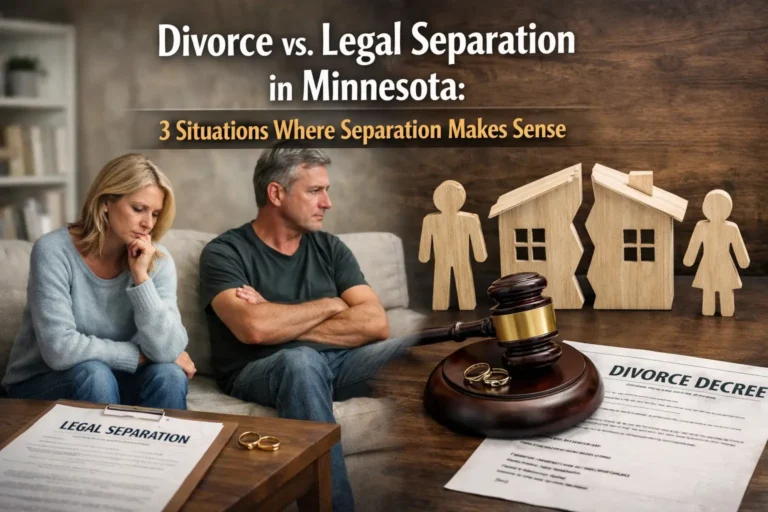
Legal Separation: A court order that divides property and sets custody and support but leaves the spouses married. It makes sense in only a few situations, usually health insurance or religious reasons. See Divorce vs. Legal Separation in Minnesota.
M
Marital Property: Everything either spouse acquired during the marriage, up to the valuation date, no matter whose name is on it. It is presumed marital, and it is divided. See the Minnesota Property Division Guide.
Marital Termination Agreement (MTA): The written settlement that resolves every issue in a divorce: property, debts, custody, parenting time and support. It is usually turned into a stipulated Judgment and Decree for the judge to sign.
Mediation: A confidential negotiation led by a neutral mediator, often a family lawyer or retired judge, who helps the parties reach an agreement. The mediator does not decide anything. See How to Win at Minnesota Divorce Mediation.
Medical Support: The part of child support that covers the child’s health and dental insurance and uninsured medical costs, divided between the parents by income share.
Motion: A formal written request asking the court to order something, such as temporary custody, support or exclusive use of the home.
N
Nonmarital Property: Property that belongs to one spouse and is not divided: property owned before the marriage, gifts and inheritances to one spouse, property traded for or grown passively from those, property acquired after the valuation date, and property excluded by a valid prenup. The spouse claiming it has to trace it.
O
Obligor and Obligee: In a support order, the obligor is the parent or spouse who pays, and the obligee is the one who receives.
Order for Protection (OFP): A court order under Minn. Stat. 518B.01 that protects a person from domestic abuse by a family or household member. It can be issued the same day without the other side present, can remove the abuser from the home and can set temporary custody.
P
Parenting Consultant: A neutral, usually chosen by agreement and named in the decree, who decides day-to-day parenting disputes so the parents do not have to go back to court for every disagreement.
Parenting Plan: A written plan that sets out the parenting time schedule, how decisions are made and how disputes are resolved. Under Minn. Stat. 518.1705, parents can use a parenting plan in place of traditional custody labels. See Minnesota Parenting Plans, What the Heck Are They?
Parenting Time: The time a child spends with each parent. It replaced the old term “visitation.” Under Minn. Stat. 518.175, each parent is presumed to be entitled to at least 25 percent of the parenting time. There is no presumption of 50/50.
Parenting Time Expeditor: A neutral appointed by the court under Minn. Stat. 518.1751 to resolve parenting time disputes quickly, first by trying to help the parents agree and, if that fails, by making a decision.
Party: A person directly involved in a court case, usually the petitioner and the respondent.
Paternity: The legal determination of who a child’s father is when the parents are not married. Paternity can be established by a signed Recognition of Parentage or by a court case. See Fathers’ Rights in Minnesota.
Petition: The document that starts a family law case and says what the person filing it is asking the court to do. In Minnesota family court, the case starts with a Summons and Petition, not a complaint.
Petitioner: The person who starts the case by serving or filing the petition.
Physical Custody: The routine daily care and control of a child and where the child lives. It can be joint or sole.
Pro Se (Self-Represented): Handling your own case without a lawyer.
Q
Qualified Domestic Relations Order (QDRO): A separate court order that tells a 401(k) or pension plan to transfer the other spouse’s share without taxes or penalties. The divorce decree alone does not divide the account. See What Is a QDRO?
R
Recognition of Parentage (ROP): A form unmarried parents can sign, often at the hospital, that legally establishes paternity. It does not give the father custody or parenting time. Until a court orders otherwise, the mother has sole custody, so the father has to bring a court case to get a schedule.
Referee: A judicial officer who hears family cases in some counties, mostly in the metro. A referee’s orders are confirmed by a district court judge.
Requests for Admission: Written statements one party asks the other to admit or deny under oath during discovery.
Requests for Production of Documents: Written requests for the other party to produce specific documents, such as bank statements, tax returns or pay stubs.
Respondent: The person who is served with the petition and responds to it.
Retainer: The money a lawyer requires up front to start a case. It is held in a trust account and billed against as work is done, and it is still yours until it is earned. See What Is a Divorce Retainer?
S
Service: Formally delivering court papers to the other party, by a sheriff, a process server or a signed Admission of Service. You cannot serve the papers yourself.
Split Custody: An arrangement where each parent has primary care of different children. Minnesota courts rarely separate siblings this way.
Spousal Maintenance: Minnesota’s term for alimony: payments from one spouse to the other after a divorce when one spouse cannot meet reasonable needs and the other can afford to help. It is decided under Minn. Stat. 518.552, which was substantially rewritten in 2024. See the Minnesota Spousal Maintenance Guide.
Stipulation: A written agreement between the parties on some or all issues, submitted to the court to become an order.
Subpoena: A court document requiring a person to testify at a hearing, trial or deposition. A subpoena duces tecum requires the person to bring or produce documents.
Summary Dissolution: A streamlined divorce under Minn. Stat. 518.195 for very simple cases: a marriage of under eight years, no children, no real estate and limited assets and debts. Few couples qualify.
Summons: The document served with the petition that tells the respondent a case has started and they have 30 days to respond. It also contains the automatic restraining provisions.
T
Temporary Relief: Court orders that set the ground rules while a case is pending, such as who stays in the house, the parenting schedule and who pays which bills. They are requested by motion under Minn. Stat. 518.131 and decided on affidavits. See What Is a Temporary Relief Hearing?
Testimony: Evidence given under oath, in court or in a deposition.
Transcript: The official written record of everything said at a hearing or deposition.
Trial: The hearing where a judge hears evidence and decides the issues the parties could not settle. There are no juries in Minnesota divorce and custody cases, and very few cases ever reach trial.
U
Uncontested Divorce: A divorce where the spouses agree on every issue, so no trial is needed. It may be a joint petition, an agreed settlement after one spouse files, or a default.
V
Valuation Date: The date marital property is valued for the divorce. In Minnesota it is the day of the initially scheduled prehearing settlement conference, unless the parties agree on another date or the court finds another date is fairer.
Visitation: The old term for a parent’s time with a child. Minnesota now calls it parenting time.
Information on minnfamilylaw.com is general information about Minnesota family law, not legal advice. Mr. Kohlmeyer is licensed in Minnesota and cannot provide legal services or guidance outside Minnesota. If you wish to retain Mr. Kohlmeyer for your family law matter, call 507-625-5000.